

Senegal 2023 Country Report Launch
September 6, 2024
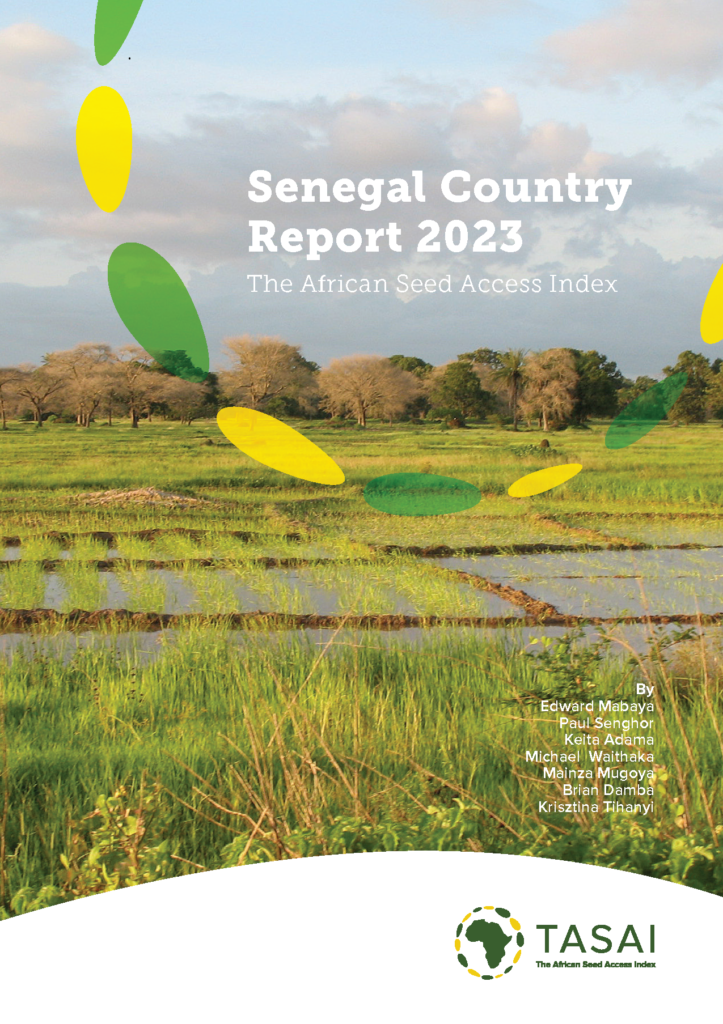
The 2023 TASAI Senegal Country Report summarizes the findings of the TASAI study conducted in Senegal in 2022 to appraise the structure and economic performance of Senegal’s formal seed sector. The assessment has found some positive developments since the last TASAI study conducted in 2017. TASAI studies focus on the four grain and legume crops important to a country’s food and nutritional security (the “four focus crops”); in Senegal, these are groundnut, millet, rice, and maize. Since the 1990s, the state has withdrawn from seed production to make way for private seed companies, which produce foundation and certified seed of the first and second generations. Breeder seed is produced by the L’Institut Sénégalais de Recherches Agricoles (ISRA), following the (Economic Community of West African States) ECOWAS seed regulations.
Under research and development, ISRA has at least one breeder for each of the four focus crops. However, ISRA’s seed production unit is constrained by a lack of qualified staff and insufficient funding, which constrains development and release of varieties. For instance, between 2020 and 2022 five maize varieties, four rice varieties, and four millet varieties were released when compared to the period between 2008 and 209 when 8 maize varieties and 16 rice varieties were released and in 2018 when 10 groundnut varieties were released. In addition, seed producers continue to produce and market older varieties. Some of the commonly sold millet and ground nut varieties are 50 years old.
Under the industry competitiveness category, there is no individual company/cooperative or group of seed companies/cooperatives that dominates the seed market for any of the four crops. This means that the seed market is competitive. The study has found that, in 2022, producers produced the highest volume of seed by weight for maize, followed by groundnut, rice, and millet. The larger volumes of maize and groundnut may be partly due to the incentive of the government subsidy program, which is the main buyer of seed for these two crops. Rice seed production was lower, partly because, rice seed producers in the Senegal River Valley opted out of the subsidy program, because it could potentially limit the competitiveness of the rice seed industry.
Senegal’s seed policy instruments are aligned with the ECOWAS seed regulations. However, the decrees and ministerial orders needed to implement the regulations are yet to be completed, which implies that implementation cannot be effected. Specifically, ministerial decrees are yet to be published for the use of the professional card for registered seed sector actors, setting seed control fees, and setting the costs of conducting the Distinctness, Uniformity, and Stability (DUS) and Value for Cultivation, Use, and Sustainability (VCUS) examinations.
Under the rubric of institutional support for the seed sector in Senegal, the study has found two national seed associations – the Union Nationale Interprofessionnelle des Semences (UNIS) and the Association Sénégalaise pour la Promotion du Développement à la Base (ASPRODEB). Both organizations serve seed producers, but ASPRODEB members include cooperatives and unions, while UNIS’ members are mainly seed producers. The two associations received high average satisfaction ratings from their members in terms of serving the needs of their constituents. Seed inspection services have been strengthened in recent years by the accreditation of private agencies for seed quality control operations. In addition, the national seed laboratory, accredited by the International Seed Testing Association (ISTA) to test rice, maize, and sorghum, has also recently received new laboratory equipment.
The study has found no major challenges in the area of service to smallholder farmers. The government’s agricultural extension services, provided by the Agence Nationale de Conseil Agricole et Rural (ANCAR), support both farmers and, to a lesser extent, seed producers. The latter work more commonly with seed technicians who are employed by seed companies and also serve as extension officers. Agro-dealer networks are adequate at the moment, partly because much of the seed of the four focus crops is distributed through the government subsidy program or is sold directly to farmers at the seed producers’ outlet.
The Senegal TASAI Country Study report was published following a successful dissemination meeting in Dakar, Senegal, on December 14, 2023, where findings were validated and discussed by members of the country’s public and private seed sectors.